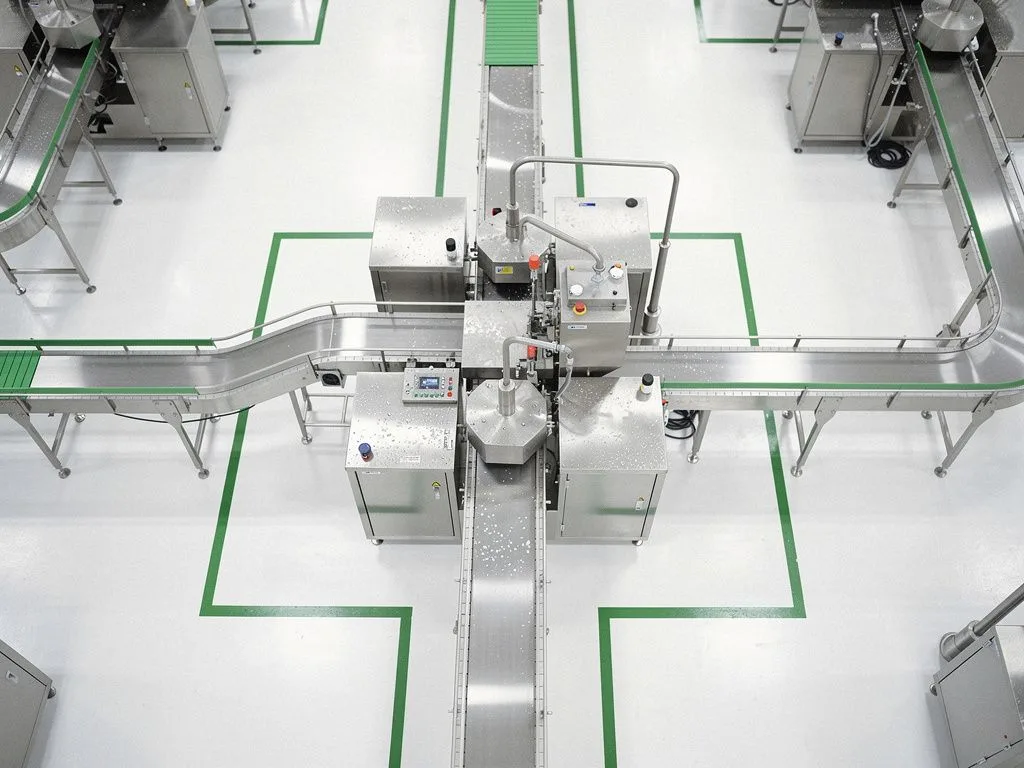
The Real Impact of Workflow Layout on Production Capacity
Workflow layout directly determines the actual output of an entire production line. Bottlenecks are often not in the machinery itself, but at the intersections where personnel flow, material flow, and process handoffs meet. When buyers review a complete plant layout proposal, they should first confirm that the raw material intake area, forming area, cooking or packaging area, and finished product exit each have independent flow paths. They should then verify per-hour capacity through actual product trials, rather than relying solely on individual machine specification sheets. At the same time, workflow layout also affects cleaning frequency and food hygiene risk—these are points that must be clarified before any quotation is considered.
Why Can a Single Machine Have High Output, but the Full Line Cannot?
Single-machine output is the theoretical ceiling of the equipment, while full-line output is constrained by the slowest station. When a filling machine can wrap 80 pieces per minute, but the preceding dough divider and the downstream tray loading and steaming steps each take 2 minutes, the entire line's rhythm is slowed by the downstream stage. When reviewing a complete plant plan, buyers should require the supplier to list the actual cycle time of each station and identify which station is the design bottleneck. If the bottleneck station has no buffer design, the line will repeatedly stop during shift changes, cleaning, and raw material replenishment, and the gap between theoretical and actual output often reaches 20% to 40%. This is why a complete plant plan must be quoted based on the full-line cycle time, not the maximum speed of a single machine.
What Real Losses Can Occur When Personnel and Material Flows Intersect?
The intersection of personnel and material flows is the most common hidden source of capacity loss in food plants. When operators must cross the raw material conveyor to reach the cleaning area, or when finished product carts must pass through the semi-finished goods area to reach the packaging area, each intersection causes waiting, collisions, and hygiene risks. When evaluating a floor plan, buyers should confirm whether the raw material intake and finished product exit are located at opposite ends of the plant, whether the clean and dirty areas are physically separated, and whether operator flow forms a one-way loop rather than back-and-forth movement. These details are not visible on a quotation, but they directly affect daily actual output and quality rejection rates. For plants in Southeast Asia, the hot and humid climate amplifies the hygiene risks at these intersections, making the value of flow separation even higher.
How Should Workflow Be Divided When Egg Processing Equipment and Filling Machines Share a Line?
When an egg liquid mixing and metering filling line, a continuous egg steaming and forming line, and filling machines share the same plant, the workflow division must be based on temperature zones and humidity zones, not product lines. Egg liquid is a high-humidity raw material, and the egg steaming and forming area generates large amounts of steam—both of which affect the dough drying speed and forming stability in the filling area. Buyers should require the supplier to mark the steam exhaust direction, drainage slope, and air conditioning return path on the floor plan, and confirm whether the egg processing area and filling area share the same ceiling air conditioning system. If they do, steam and flour dust will cross-contaminate, which is especially noticeable in high-temperature markets such as Thailand. In a complete plant plan, egg processing equipment should be concentrated on one side and filling machines on the other, separated by a buffer corridor and independent air conditioning.
Six-Point Checklist for Planning Buyer Verification Workflow
Raw Material Intake and Finished Product Outlet at Opposite Ends
Confirm that the raw material intake and finished product outlet are located at opposite corners or ends of the plant to avoid cross-contamination between raw materials and finished products in the same passage. This is a basic requirement for food hygiene and workflow efficiency.
Documented Cycle Time for Each Station
Require the supplier to provide cycle time data for each station and identify the bottleneck station. The production line pace is determined by the slowest station, not the fastest.
One-Way Loop Design for Personnel Flow
The operator's path from raw material intake, cleaning, forming, packaging to shipping should be one-way, avoiding crossing other work areas to prevent waiting and contamination.
Physical Separation of Temperature and Humidity Zones
The egg liquid area, steaming area, and filling area should have independent air conditioning and steam exhaust systems to prevent temperature and humidity from affecting product stability.
Separation of Cleaning and Production Areas
CIP cleaning, cleaning tool storage, and the production line itself should be physically separated. The cleaning workflow should not pass through the semi-finished product area.
Verification Through Trial Runs with Actual Products
Require the supplier to conduct trial runs using the buyer's actual raw materials and product specifications, recording actual hourly output and downtime frequency as the basis for acceptance.
Who Bears the Cost of Workflow Changes in Turnkey Projects?
A common point of dispute in turnkey projects is the responsibility for workflow changes. If the buyer does not clearly specify the plant dimensions, column positions, drainage points, and power capacity before signing the contract, any workflow adjustments after construction may incur additional costs. The buyer should require the supplier to provide at least two versions of the floor plan in the contract and include a clause stating that 'no additional fees will be charged for up to one workflow change.' At the same time, the buyer should retain the right to confirm the final workflow after trial runs with actual products, avoiding locking in all equipment positions at the paper stage. For buyers in Southeast Asia, such as Thailand, where plants are often leased, the flexibility for workflow changes is more limited than in owned plants, making prior confirmation even more critical.
How Does Workflow Planning Affect Future Expansion and Product Changes?
Workflow planning not only determines current capacity but also the flexibility for future expansion and line changes. If the workflow is designed as a one-way straight line, new machines can only be added at the end of the line. If designed as a U-shaped or L-shaped loop, expansion can be done from the side or outside the loop, making better use of space. The buyer should evaluate the product line expansion plan for the next three to five years, such as whether to expand from dumplings to potstickers, or from egg liquid filling to steamed egg forming, and require the supplier to reserve expansion areas and utility connection points on the floor plan. If the workflow does not reserve expansion space, future expansion often requires relocating the entire line, which costs far more than prior planning. This is also the biggest difference between whole-plant planning and piecemeal equipment procurement: whole-plant planning must leave room for the future, while piecemeal procurement is each for itself.
How Should Buyers Present Workflow Requirements to Suppliers?
When presenting workflow requirements to suppliers, buyers should prepare four basic items: the actual plant dimension drawing (including column and door/window positions), the list of planned products and daily target output, the current labor allocation, and the expansion plan for the next three to five years. If any of these four items is missing, the workflow planning can only be based on experience and guesswork, and the likelihood of the buyer bearing subsequent change costs is extremely high. The buyer should also proactively ask whether the supplier offers trial run services and whether the trial run is conducted at the buyer's plant or the supplier's facility. For equipment with high product differentiation, such as egg processing equipment and filling machines, trial runs must use the buyer's actual raw materials; otherwise, the capacity data is for reference only. The more complete the preparation, the higher the accuracy of the workflow planning and the lower the risk of subsequent additional costs.
Provide Your Factory Dimensions and Product List to Get a Customized Layout Plan
Please prepare the actual dimensional drawings of your factory, the list of products you intend to produce, and your daily target output, then contact TWB2B 食品機械 DemoSite Food Machinery Co., Ltd. to receive a quotation for a complete factory layout plan and trial run verification.