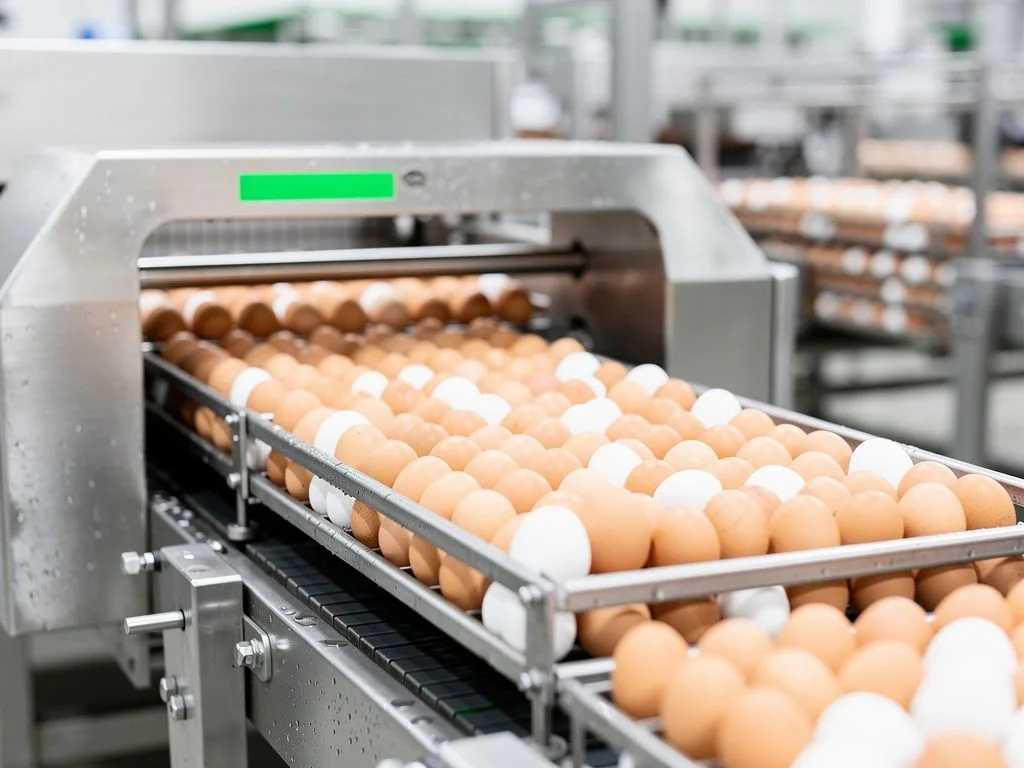
How to Select Egg Washing, Shelling, and Grading Equipment
Selecting egg washing, shelling, and grading equipment requires answering three questions first: whether the egg source is fresh or refrigerated eggs, the hourly processing capacity of the line, and whether the end product is shell-on graded eggs or shelled eggs entering a filling line. Only after confirming these three points can you decide between brush or spray washing, centrifugal or continuous shelling, and weight-based or optical grading. Skipping this preliminary assessment and directly comparing prices is the most common selection mistake made by Southeast Asian buyers.
Should the Washing Section Use Brush or Spray Type?
The core question for the washing section is: are the contaminants on the eggshell mainly dust or mainly adhered feces? If the egg source comes from battery cage farms and the shells are mainly dusty, a brush-type washing machine can meet the cleanliness requirements, with lower equipment cost and maintenance frequency. If the eggs come from free-range or pasture-raised farms and the shells often have adhered feces, an upgrade to spray-type or a combined brush-plus-spray system is needed, and you should also assess whether warm water washing is required to avoid shell cracking from temperature differences. In Southeast Asia's tropical climate, moisture on eggshell surfaces evaporates quickly, so whether a drying section is needed after washing should also be included in the selection considerations. The processing capacity of the washing section must be greater than or equal to the maximum output of the downstream shelling and grading sections; otherwise, a bottleneck will form at the front end.
Should the Shelling Machine Be Centrifugal or Continuous?
The key question in choosing a shelling machine is: does the end product require high egg liquid integrity, or is a small amount of shell fragment contamination acceptable? Centrifugal shelling machines use high-speed rotation to crack the shells, making them suitable for harder refrigerated eggs, with a larger hourly processing capacity, but the egg liquid breakage rate is relatively higher, and they are commonly used in industrial egg liquid raw material plants. Continuous shelling machines process eggs one by one using a conveyor belt with shelling blades, offering better egg liquid integrity, and are suitable for scenarios where the downstream directly enters a filling line, such as chawanmushi, pudding, or steamed egg forming lines. For Southeast Asian buyers, if the end product is shell-on graded packaging, a shelling section is not needed, and only washing and grading need to be evaluated; if the end product is shelled egg liquid or steamed egg products, the choice of shelling machine directly affects the final product yield.
Should the Grading Section Use Weight-Based or Optical Type?
The selection question for grading equipment is: is the grading basis egg weight or external quality? If only weight-based grading is needed (for example, into large, medium, and small grades), a weight-based grading machine is sufficient, with lower equipment investment and simpler maintenance. If defective eggs need to be removed based on external defects such as shell cracks, dirt, or blood spots, an upgrade to an optical grading machine is required, which uses image recognition to automatically remove them, but equipment cost and calibration time will increase. Common egg processing plants in the Southeast Asian market mainly use weight-based grading as the primary option, with optical grading as an advanced option. During selection, you should also confirm the rejection mechanism for defective eggs in the grading section—whether they fall into a waste egg tank or are automatically diverted to a by-product line—as this affects the overall plant space layout.
Six Supporting Items to Confirm During Machine Selection
Egg Source Specifications and Incoming Temperature
The differences between fresh, refrigerated, or room-temperature eggs directly determine the washing water temperature and the shelling machine model. Request egg source samples for testing before purchasing.
Hourly Processing Capacity Range
Set the capacity range based on actual orders and future expansion plans to avoid purchasing an oversized machine that sits idle or an undersized one that creates a bottleneck.
Tolerance for Breakage Rate
Whether the end product is in-shell graded eggs or shelled liquid eggs, the acceptable breakage rate differs. This indicator determines the choice of shelling section machine model.
Cleanliness Requirements and Water Availability
The water consumption and quality requirements of the washing section should be evaluated together with the local tap water or groundwater conditions at the plant site.
Interface Requirements with Downstream Filling Lines
If the washing, shelling, and grading line is the front end of a filling line, the conveyor speed and egg liquid temperature must match the downstream filling machine.
Plant Space and Electrical Configuration
The washing section requires drainage, and the shelling section requires stable power. Plant height and power distribution capacity should be assessed before machine selection.
Three Common Mistakes in Machine Selection in the Southeast Asian Market
Southeast Asian buyers commonly make three mistakes when selecting washing, shelling, and grading equipment. First, they directly apply European or American machine specifications to local egg sources, ignoring the hardness difference between room-temperature eggs in Southeast Asia and refrigerated eggs in Europe and America, resulting in a high breakage rate during shelling. Second, they compare only the unit price of the machine and ignore the overall plant planning costs. If the washing, shelling, and grading sections do not have unified conveyor speeds and control systems, the subsequent integration costs will be even higher. Third, they fail to reserve space for expansion. The initial selection is too compact, and when capacity becomes insufficient within six months, the entire line must be replaced. It is recommended that buyers provide egg source samples, target output, and plant dimensions at the inquiry stage, and request a complete line quotation that includes the conveyor section and control system, rather than a single-machine quotation.
How Does Plant Planning Connect with Equipment Selection?
The issue of connecting plant planning with equipment selection is: are the washing, shelling, and grading sections integrated by the same supplier? If different suppliers provide each section, the responsibility for the interface of the conveyor belts, control systems, and cleaning procedures is unclear, and maintenance can easily lead to finger-pointing. If Southeast Asian buyers choose a supplier with plant planning capabilities, they can request a complete flow diagram from egg intake, washing, shelling, and grading to downstream filling, with the dimensions, water and power requirements, and operator allocation for each section marked. The value of plant planning lies in identifying bottlenecks in advance, not in remedying them afterward. TWB2B 食品機械 DemoSite Food Machinery Co., Ltd. provides plant planning and turnkey project services, and can provide customized quotations based on the plant and product specifications. Buyers can use the six supporting items listed on this page as a self-check list before making an inquiry.
What Information Should Buyers Prepare Before Making an Inquiry?
The question of what information buyers should prepare before making an inquiry is: what information enables suppliers to provide accurate machine selection recommendations? The most basic four items include: egg source specifications (fresh or refrigerated eggs, egg weight range, incoming packaging form), target output (hourly processing volume or daily shift output), end product form (in-shell graded, shelled liquid eggs, steamed egg products, or others), and plant conditions (available space length, width, and height, power capacity, water source). If any of these four items is missing, the quotation can only be presented as a range and cannot be precise. Southeast Asian buyers often omit plant conditions due to language or habits, causing suppliers to quote based on European or American standard plant assumptions, only to discover at installation that the power distribution or drainage does not match. It is recommended that buyers prepare these four items at the first inquiry and request the supplier to reply with equipment dimensions and power and water specifications as a basis for subsequent price comparison.
Ready with Egg Source and Plant Information? Start Your Inquiry
Compile the answers to the seven questions in this checklist into a document, along with photos of the egg source samples, to expedite model selection, quotation, and whole-plant planning discussions.