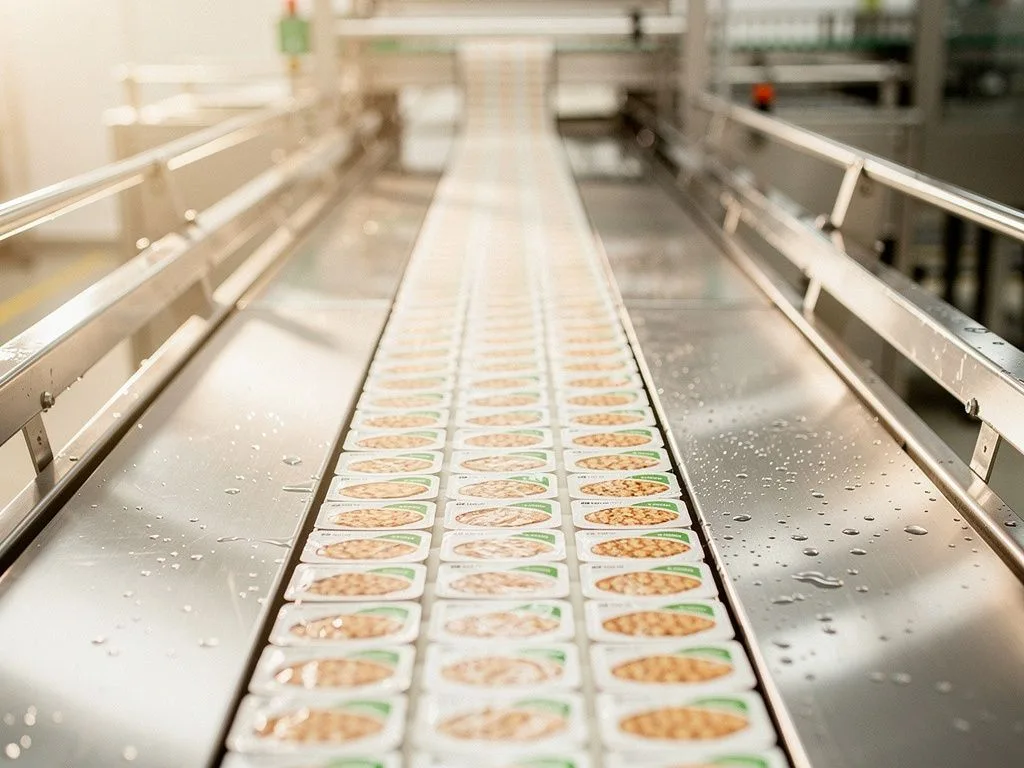
How Yield and Rework Affect Effective Capacity
Yield and rework rate are the two key variables that determine effective capacity. Theoretical capacity must be reduced by defective units and rework time to arrive at the output actually available to the buyer. When evaluating egg processing equipment, filling machines, or complete plant planning, yield benchmarks, scrap conditions, rework processes, and downtime costs should all be factored into the calculation to avoid estimating lead times and pricing based on theoretical capacity.
Why Theoretical Capacity Does Not Equal Actual Output
Theoretical capacity is the output a machine can produce under ideal continuous operation, but actual output is reduced by yield and rework. Yield refers to the proportion of products that pass inspection on the first attempt, while rework refers to the time and labor spent returning defective products to the production line for reprocessing or repair. For egg liquid mixing and metered filling lines, filling volume errors, air entrapment, and poor sealing directly affect yield. For filling machines, common sources of defects include uneven crust thickness, incomplete sealing, and off-center filling. When comparing equipment, buyers should ask suppliers for yield test conditions and samples rather than only looking at output per minute. Actual usable capacity must be calculated based on the number of conforming units after yield, and rework time must be added back into labor costs to reflect true unit cost and lead time. For example, a filling line rated at 60 pieces per minute with a first-pass yield of only 80% effectively produces only 48 conforming pieces per minute. If the remaining 12 pieces enter rework, they will additionally occupy machine time and labor, disrupting the entire line's rhythm, and downstream processes such as drying, cooking, or packaging will have to be rescheduled accordingly. If buyers estimate monthly output based on theoretical capacity alone, they often overestimate actual deliverable quantities, leading to material shortages at the customer end or an inability to respond promptly to additional orders.
How Should Yield Benchmarks Be Set to Be Reasonable?
Yield benchmarks should be set based on product type, material characteristics, and batch size, rather than applying a single number. For egg processing equipment, yield benchmarks are typically based on three criteria: filling volume tolerance, seal integrity, and visual defects. For filling machines, the main criteria are crust weight, filling weight, formed dimensions, and sealing tightness. Buyers should agree on sampling ratios, inspection methods, and acceptance criteria with suppliers during the quotation stage and include them in procurement specifications. For new products or new formulations, it is recommended to first verify yield through small-batch trial production before scaling up to mass production. If yield benchmarks are not agreed upon in advance and defect rates are found to be high after mass production, the only option is often to absorb the losses through rework, leading to delayed delivery and cost overruns. In practice, buyers can classify products by risk: for regular items, use historical yield as the benchmark; for new items, use trial production data as the benchmark, and require suppliers to provide yield ranges under continuous operation rather than single-point figures. Material moisture content, viscosity, and temperature sensitivity can cause yield to fluctuate across different batches of raw materials. If the benchmark is set too tight, the rework ratio will spike during mass production; if set too loose, defective products will flow to the customer. Buyers should specify in the contract the acceptable range and the handling method when the range is exceeded, such as return for rework, price reduction, or scrapping, so that the yield benchmark becomes a truly enforceable specification.
Six Key Indicators to Evaluate When Assessing Yield and Rework
First-Pass Yield
The proportion of finished products that pass inspection on the first attempt. It is the starting point for calculating effective capacity and should be tracked separately by product type.
Defect Classification and Flow
Distinguish between reworkable and non-reworkable defects. The time cost of returning reworkable items to the line must be accounted for separately.
Rework Process and Labor Hours
Whether rework requires disassembly, cleaning, or re-forming, each step consumes line time and labor.
Downtime and Changeover Frequency
Downtime caused by specification changes, cleaning, and maintenance directly reduces effective capacity.
Material Loss and Scrap Cost
Whether the raw material cost of defective products can be recovered affects overall unit cost and profit.
Yield Inspection and Recording Method
Whether sampling frequency, inspection tools, and record forms are standardized determines the credibility of yield data.
How Much Production Capacity Do Rework Processes Consume?
The impact of rework processes on production capacity is often underestimated, because rework not only consumes machine time but also ties up labor, floor space, and material flow. Taking a filling machine as an example, if dumplings with forming defects need to be disassembled and re-wrapped, it is equivalent to running the entire process again. This disrupts the production line rhythm, and downstream scheduling for drying or steaming must also be adjusted. If a continuous egg steaming line has uneven filling amounts, the rework approach may be to scrap the entire batch or perform manual repair. The former directly consumes raw material costs, while the latter consumes labor hours. When evaluating, buyers should ask suppliers to explain the standard operating procedures for rework, the required manpower and time, and include rework costs in the unit cost calculation. If the rework rate is high, the overall plant planning should reserve a rework area and buffer capacity to avoid scheduling bottlenecks. In practice, rework can be divided into inline rework and offline rework: inline rework is redoing the work directly on the same machine, which interrupts continuous production; offline rework moves defective products to another workstation for processing, allowing the main line to continue running, but requires additional labor and floor space. Buyers should decide which method to use based on product value and defect rate, and include the corresponding labor hours and space requirements in the overall plant configuration. For high-value products or those with strict hygiene requirements, inline rework may actually be more cost-effective than offline rework, as it can reduce secondary contamination and handling damage.
How Do Yield Fluctuations Affect Delivery Schedules and Quotations?
Yield fluctuations are one of the main causes of inaccurate scheduling, especially during new product introduction or when there are significant differences between material batches. When the yield drops from the expected high level, daily qualified output falls short of the schedule, and delivery dates are naturally delayed. For buyers, this means that when requesting quotations, they should not only ask about machine capacity but also about the supplier's backup plans for yield fluctuations, such as whether they offer quick mold changes, support small-batch trial production, or assist in establishing inspection SOPs. For overall plant planning and turnkey projects, the yield ramp-up period should be included in the timeline, treating the initial lower-yield phase as a learning curve rather than directly estimating delivery dates based on mass production yield. In terms of pricing, yield and rework costs should be transparently disclosed to avoid additional charges being added later. When negotiating, buyers can ask suppliers to provide quotation tiers corresponding to yield ranges, for example, a standard price when the yield reaches a certain level, and a rework surcharge when the yield falls below a certain level, directly linking the cost structure to yield performance. For seasonal raw materials or imported materials, yield fluctuations are often difficult to predict, so buyers should specify material acceptance standards and yield responsibility in the contract to avoid disputes over responsibility when yield declines.
How Can Yield and Rework Be Incorporated into Equipment Purchase Decisions?
To incorporate yield and rework into purchase decisions, buyers should establish a quantitative basis starting from the quotation stage. When requesting quotations, in addition to capacity and specifications, they should also request yield test conditions, sample inspection reports, and rework process descriptions, and ask the supplier to arrange trial production or sampling. The trial production stage is a key opportunity to verify yield and rework costs. Buyers should send personnel to observe on-site, recording defect types, rework counts, and downtime causes. The purchase contract should clearly define yield benchmarks, acceptance conditions, and rework responsibility to avoid disputes after mass production if yield does not meet expectations. In overall plant planning, the buffer design for yield and rework should be considered in sync with the production line rhythm to ensure actual output aligns with scheduling needs. Buyers can ask suppliers to provide yield distribution charts and rework labor hour statistics after trial production as a baseline for subsequent mass production. If trial production yield does not meet expectations, equipment parameters or material formulations should be adjusted before entering mass production, rather than directly using discounted prices to mask yield deficiencies. For production lines that share multiple products, yield benchmarks should be calculated separately by product to avoid a single benchmark masking the defect rate of specific products.
What Information Should Buyers Prepare When Asking Suppliers About Yield?
Before asking suppliers about yield, buyers should first organize their own product specifications, material characteristics, and target production volume so that suppliers can provide yield estimates that are close to reality. The required information includes product dimensions and weight ranges, material viscosity or moisture content, planned daily production hours, acceptance standards, and sampling ratios. If the product has multiple specifications, the frequency of specification changes should also be explained, as the number of line changes affects overall yield. For filling machines, the filling formula and dough formula are key variables affecting yield and should be provided as well. The more complete the information, the better suppliers can confirm yield ranges and rework costs based on actual specifications, and quotations will be closer to reality. Buyers should also describe the production line environment, such as factory temperature and humidity, cleaning frequency, and manpower allocation, as these indirectly affect yield and rework frequency. If buyers already have yield data from existing production lines, they should also provide it as a reference baseline for estimating the yield of new equipment. For buyers introducing mechanization for the first time, they should explain the defect rate and rework methods of the current manual or semi-automatic process so that suppliers can assess the expected yield improvement after mechanization.
How should yield buffer zones be reserved during factory planning?
When planning a factory layout, the yield buffer zone should be determined based on a comprehensive assessment of product mix, defect rate ranges, and rework methods. For new product lines with higher defect rates, larger rework areas and buffer inventory should be reserved to prevent defective products from accumulating and disrupting the main production flow. For mature products with stable defect rates, the buffer zone can be appropriately reduced to save factory space. The design of the buffer zone should also consider material characteristics—for example, egg-based products require low-temperature temporary storage, while filled products need protection from skin drying and cracking—all of which affect the environmental configuration of the buffer zone. When discussing with a factory planning supplier, buyers should clearly communicate the yield estimates and rework frequency for each production line so that the factory layout truly matches actual output requirements. If the buffer zone is insufficient, scheduling bottlenecks are likely to occur during the initial production ramp-up period when yields are still improving; if it is over-reserved, factory costs and material inventory pressure will increase. Buyers can ask the supplier to provide three buffer configuration options based on yield ranges, along with explanations of how each option affects unit cost and delivery stability, to serve as a basis for decision-making.
Need to evaluate yield and effective capacity based on your products?
Provide your product specifications and target output volume, and we will confirm the yield baseline and factory configuration recommendations based on the actual specifications, helping you calculate effective capacity clearly.