What are the surface treatment requirements for food contact surfaces in food machinery?
The surface treatment requirements for food contact surfaces in food machinery center on three key factors: material selection, machining precision, and cleanability. Most international buyers require austenitic stainless steel such as SUS 304 or SUS 316 for contact surfaces. The surface roughness Ra value is determined by product viscosity and cleaning frequency. Welds must be polished to match the base material, and grooves, dead corners, and threaded channels that can trap product must be avoided. Buyers should request material certificates and surface roughness data from suppliers during the inquiry stage and agree on acceptance criteria in writing to have a basis for factory acceptance inspections.
Why must food contact surfaces use specific grades of stainless steel?
Food contact surfaces must use specific grades of stainless steel because ordinary carbon steel releases rust that contaminates products in moist or salty environments, and its surface porosity can harbor microorganisms. SUS 304 is the general choice for ambient or low-temperature processing of egg liquid, dough, fillings, and similar products, balancing cost and corrosion resistance. SUS 316 contains molybdenum, offering better corrosion resistance in chloride-containing environments such as brine fillings or fermented products. Buyers should be aware of the differences between "304" and similar grades like "304D" and "201"; the latter have higher manganese content and lower corrosion resistance, making them unsuitable for parts in prolonged food contact. During inquiries, buyers must require suppliers to state the actual grade and heat number on material certificates and compare them with the chemical composition from incoming inspection to avoid receiving substandard materials after the entire plant is delivered.
What Ra surface roughness value should be specified?
The appropriate Ra surface roughness value depends on product characteristics and cleaning methods; there is no single standard that applies to all machines. Generally, for contact surfaces handling high-viscosity materials such as egg liquid or fillings that tend to accumulate in recesses, Ra ≤ 0.8 μm is recommended. For low-viscosity liquids or components that are flushed frequently, Ra ≤ 1.6 μm may be acceptable. A lower Ra value means a smoother surface with less microbial adhesion and residue, but polishing costs increase accordingly. Buyers should require suppliers to specify the "contact surface Ra value" and "measurement locations" in the contract, and agree on the reference section (e.g., mold core, metering cylinder, forming tube inner wall) to avoid disputes during acceptance. For products with high sugar, high oil, or particulate fillings, polishing direction and cleaning flow must also be considered, as the roughness number alone does not guarantee hygiene.
Six acceptance points for food contact surface treatment
Material grade and material certificate
Contact surfaces must be SUS 304 or 316, with a heat number material certificate; chemical composition must be verified upon incoming inspection.
Surface roughness Ra value
Set Ra ≤ 0.8 or 1.6 μm based on product viscosity; specify measurement locations and reference sections in the contract.
Weld treatment quality
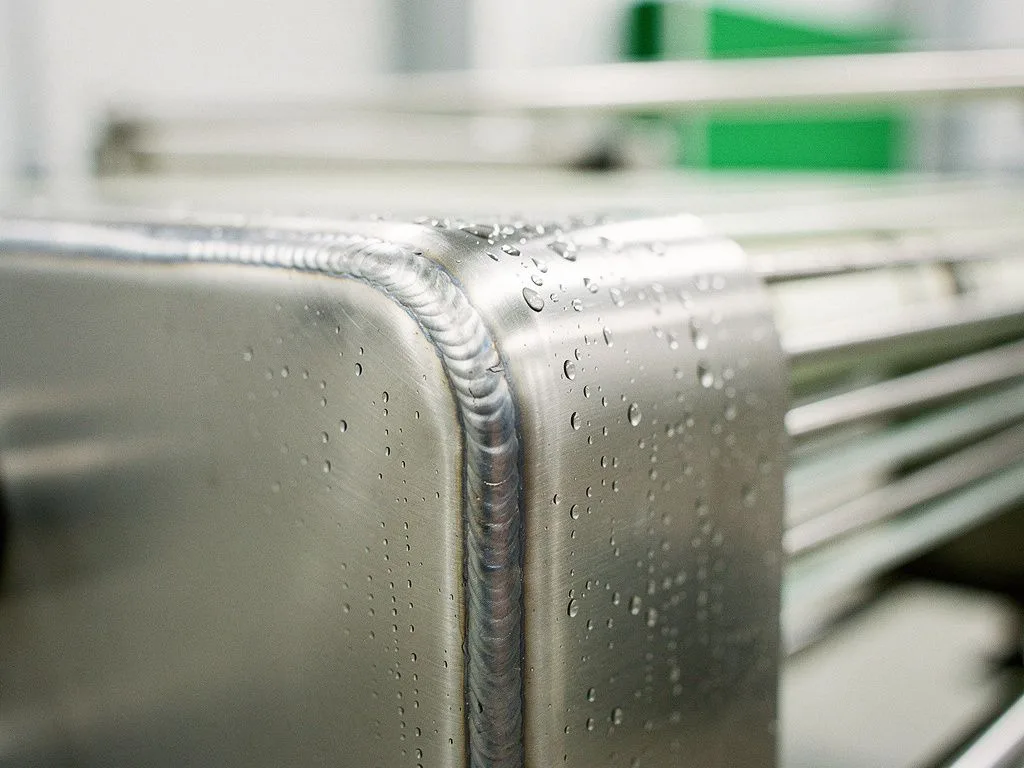
Welds must be ground and polished to match the base material, free of slag, porosity, and incomplete fill, and pass dye penetrant testing.
Dead corners and product entrapment design
Avoid grooves, sharp corners, and threads that can trap product; all contact surfaces must be visually inspectable or disassemblable for cleaning.
Seals and gasket materials
O-rings and gaskets must be food-grade silicone, EPDM, or PTFE, with temperature range and replacement intervals specified.
Cleanability documentation
Suppliers should provide CIP or manual cleaning flow diagrams, indicating disassembly points, brushing directions, and rinse angles.
Why is weld seam and joint treatment the most overlooked aspect by buyers?
Weld seam and joint treatment is the most overlooked aspect by buyers because even if a weld appears smooth on the surface, internal defects such as porosity, slag inclusions, and lack of fusion can still exist. Over time, these defects become breeding grounds for microorganisms and food residue. For food machinery, contact surface welds should be performed using TIG (argon arc) welding, and after welding, the surface should be ground to match the Ra value of the base material, followed by dye penetrant testing (DPT) to confirm there are no surface cracks. During acceptance, buyers can use a clean white cloth to wipe along the weld and check for residual iron powder or discoloration, which is a simple way to assess polishing quality. For high-risk components such as the dosing cylinder of an encrusting machine or the filling valves of egg liquid equipment, buyers should require the supplier to submit weld photos and inspection reports before shipment, and specify in the contract the "weld defect acceptance criteria" and "re-inspection procedures" to ensure a defensible position during post-delivery sanitation audits.
How should seals, gaskets, and lubricating grease be considered?
The key to considering seals, gaskets, and lubricating grease is that these non-metallic components are also food contact surfaces, yet they are often overlooked by buyers during initial specification review. O-rings, gaskets, and sealing strips should be made of food-grade silicone, EPDM, or PTFE, and should be marked with their temperature resistance range and applicable pH value. General industrial NBR rubber contains carbon black and vulcanizing agents, making it unsuitable for prolonged food contact. Lubricating grease for moving parts must be food-grade H1 grade, not general industrial grease. Buyers should require suppliers to list the model numbers, suppliers, and material certifications for all seals and grease, and agree on the "replacement cycle for consumables" and "timing for first replacement." For components that operate at high temperatures or high frequency, such as continuous egg steaming lines and encrusting machine dosing systems, seal life directly affects product hygiene and downtime losses, and this cost should not be sacrificed during the procurement stage.
Are there additional surface treatment requirements for the Southeast Asian market?
The answer to whether the Southeast Asian market has additional surface treatment requirements depends on the target country and product category, but there are several common trends worth noting for buyers. Food factories in Thailand, Vietnam, and Indonesia, which increasingly handle OEM orders from Western buyers, generally require contact surfaces to comply with the principles of HACCP and ISO 22000. Although local regulations may not specify Ra values, in practice they reference the EU EHEDG and US 3-A sanitary standards. The hot and humid tropical climate raises the corrosion resistance requirements for stainless steel, and the use of SUS 316 is more common than in Taiwan. When requesting quotes, buyers should proactively state the "export destination country" and "whether the end customer is a Western brand" so that suppliers can adjust the material and surface treatment solutions accordingly. For turnkey plant projects, the contract should specify three items: "contact surface material list," "surface treatment inspection reports," and "cooperation with local sanitation authorities for acceptance," to avoid rework due to detail discrepancies after arrival at the plant.
What written documentation should buyers request when requesting quotes?
When requesting quotes, buyers should clearly list the required written documentation during the technical agreement stage rather than waiting until acceptance. Essential documents include: material certificates for contact surfaces (indicating grade, heat number, and chemical composition), surface roughness inspection reports (indicating measuring instrument and location), weld treatment records (including welding procedure and polishing process photos), material certifications for seals and grease, and cleanability documentation or flow diagrams. For high-sanitation-risk machines such as egg liquid equipment and encrusting machines, it is recommended to additionally request "contact surface development drawings" and "CIP suitability assessment." All documents should be provided with the machine before shipment, and the contract should include a clause stating that "shipment is not permitted if documentation is incomplete." The more specific the documentation requirements, the better suppliers can execute them during the manufacturing stage, which is the most effective way to reduce disputes after delivery and a fundamental action for buyers to protect their own interests.
Put Surface Finish Specifications in Your RFQ from Now On
Please inform us of your product type, production line scale, and export countries to receive recommended food contact material and surface finish solutions.