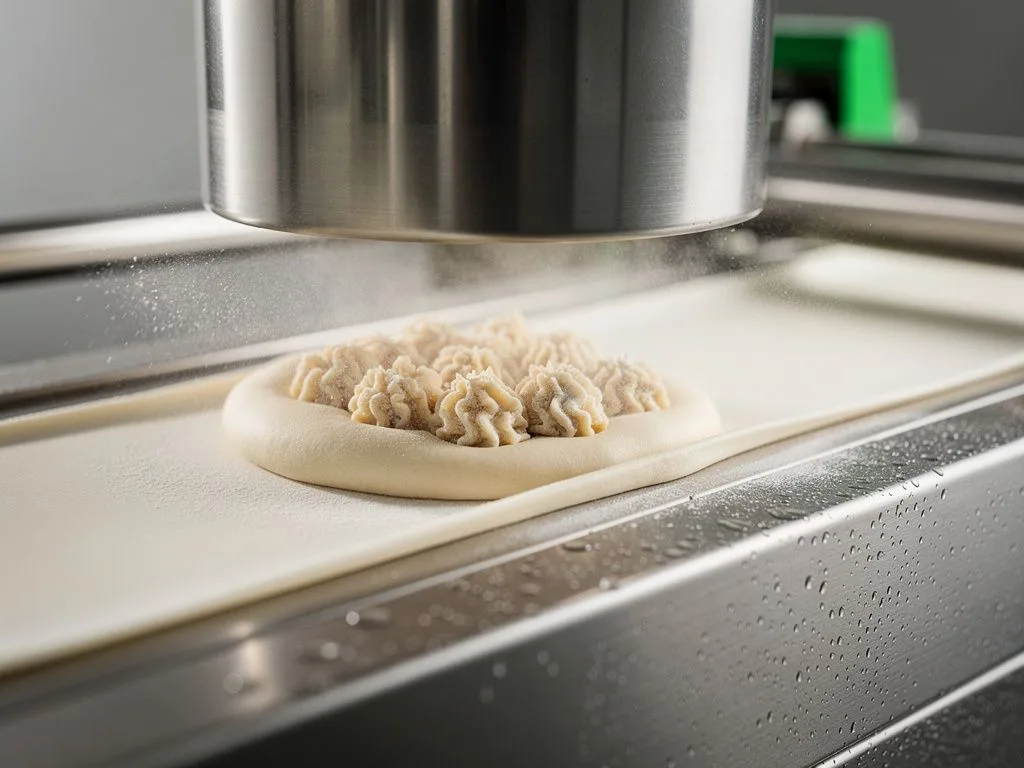
Time Cost of Line Changeover and Cleaning
When dumplings, potstickers, and wontons share the same production line, the time cost for each line changeover and cleaning typically ranges from 30 minutes to several hours, depending on the differences in forming molds, the degree of filling residue, and cleaning standards. If buyers plan capacity based on shared machine usage, they must include changeover and cleaning time in the daily effective working hours; otherwise, order scheduling will diverge from actual output. TWB2B 食品機械 DemoSite Food Machinery's filling machines and forming lines are designed with detachable molds and contact surfaces to shorten the changeover and cleaning process, but the actual savings depend on product specifications and the plant's SOP.
Where does the time for line changeover and cleaning mainly go? Three key stages.
The time cost of line changeover and cleaning is mainly spent in three stages: disassembly and assembly of molds and formers, cleaning of filling contact surfaces, and hygiene verification and drying. First, disassembling and assembling molds and formers is a physical task. The double-sided embossing wheels of a dumpling machine, the folding former of a potsticker machine, and the thin-wrapper wrapping mechanism of a wonton machine have different structures. When sharing a machine, the entire set must be replaced, and the disassembly time varies by machine design. For a typical medium-sized filling and forming line, an experienced operator usually takes 15 to 30 minutes to complete one mold change, but this can be longer if locating pins are worn or latches are stuck. Second, filling contact surfaces include the filling supply tube, forming molds, and conveyor belt. Cleaning requires disassembly, scrubbing, and rinsing. The adhesion of meat filling and vegetable filling differs, so the cleaning procedures also differ. High-fat pork filling tends to form a film on the inner wall of the filling supply tube, requiring hot water and neutral detergent for thorough removal. High-moisture chive or cabbage filling tends to accumulate fibers in the grooves of the forming mold, requiring groove-by-groove scrubbing; otherwise, black spots may appear on the wrapper surface of the next batch. Third, hygiene verification includes visual inspection, swab tests, and drying time. If the plant is equipped with an ATP luminometer or swab testing, the verification itself also takes time. When evaluating, buyers should request a detailed time breakdown for these three stages from the supplier, rather than relying solely on verbal claims of "quick changeover." They should cross-reference the time breakdown with their own plant's cleaning equipment configuration to obtain a realistic figure.
Six Key Variables Affecting Line Changeover and Cleaning Time
Forming Mold Differences
Dumplings, potstickers, and wontons use different forming principles. Mold interchange requires complete disassembly and assembly; the greater the difference, the longer the changeover.
Filling Moisture and Fat Content
High-moisture or high-fat fillings are more adhesive, requiring scrubbing plus rinsing, and drying time is also extended.
Detachable Contact Surface Design
If contact surfaces feature quick-release structures with no dead corners, disassembly and scrubbing time can be shortened; otherwise, tools are required.
Cleaning Equipment Configuration
If the plant is equipped with CIP cleaning, high-pressure washers, or ultrasonic cleaning tanks, cleaning time can be significantly reduced.
Hygiene Verification Standards
The more rigorous the verification process (e.g., ATP testing, visual inspection with photo records), the more time the verification itself takes.
Operator Proficiency
For the same changeover procedure, the time difference between an experienced operator and a novice can be as much as double; training costs should also be factored in.
Why Is the Changeover Cost of Shared-Line Production Often Underestimated?
The changeover cost of shared-line production is often underestimated because the quotation stage only calculates "production time" and ignores "non-production time." When buyers request quotes, suppliers typically provide capacity figures for a single product, but in actual scheduling, a day may involve producing three items—dumplings, potstickers, and wontons. Each changeover consumes 30 minutes to 2 hours. If changeovers occur three times a day, effective output is reduced by 1.5 to 6 hours. Additionally, the machine is idle during changeover, but utilities and labor continue to be consumed. These hidden costs do not appear on the machine quotation. When evaluating a shared-line solution, buyers should ask the supplier to provide a daily effective capacity calculation that includes changeover time, and compare it with their own order structure to see if production can be consolidated to reduce changeover frequency. They should also include cleaning agents, wiping cloths, and testing consumables in monthly costs; otherwise, even if the machine price looks attractive, the total cost of ownership may exceed expectations.
How Does Order Structure Determine the Frequency of Changeover Cleaning?
Order structure directly determines the frequency of changeover cleaning, which in turn affects total time costs. If a buyer's orders are dominated by a single item in large volumes—for example, a one-time order of 100,000 dumplings—changeover cleaning only needs to be performed once after the batch is completed, allowing the time cost to be amortized. However, if the buyer serves clients with dispersed distribution channels—for instance, needing to deliver 20,000 units each of dumplings, potstickers, and wontons within the same week, with different packaging specifications—the number of changeovers will surge, and total cleaning time may account for 10% to 20% of daily working hours. It is recommended that buyers, before planning a shared production line, first review the product mix of orders over the past three months, calculate the average changeover frequency, and then decide whether it is worth investing in machines with quick-changeover capabilities or adopting a dedicated-machine configuration. If the product mix is too dispersed, they may also consider outsourcing low-volume items to contract manufacturers, reserving the main production line for high-volume items to reduce changeover frequency.
How Does Changeover Cleaning Time Affect Delivery Commitments?
Changeover cleaning time directly affects the feasibility of delivery commitments, especially for orders with short lead times and multiple product items. When a buyer promises a 3-day delivery to customers, but the production line requires two changeovers per day, each taking 1.5 hours, effective output will shrink and the risk of on-time delivery failure rises. Additionally, if changeover cleaning does not meet hygiene standards, the batch may need to be scrapped or reworked, further impacting delivery schedules and costs. Before signing delivery terms with downstream customers, buyers should confirm the standard working hours for changeover cleaning with the equipment supplier and reserve buffer time. TWB2B 食品機械 DemoSite Food Machinery, during the plant planning stage, recommends machine configurations and changeover workflows based on the customer's order structure, but specific working hours are subject to actual trial production. It is recommended that buyers schedule trial production before signing contracts, using real data as the basis for delivery commitments rather than relying on theoretical capacity.
How Can Changeover Cleaning Time Be Transformed from a 'Hidden Cost' into a 'Controllable Variable'?
The way to turn changeover cleaning time from a hidden cost into a controllable variable is to establish standard operating procedures and quantify records. First, buyers should require suppliers to provide a complete changeover cleaning SOP at machine delivery, including disassembly and assembly sequences, cleaning agent types, rinse water pressure, and drying time. Second, after each changeover, record actual working hours and abnormal conditions; after three months, the true changeover cost of the production line can be determined. Third, adjust order scheduling based on these records, concentrating production of the same item to reduce changeover frequency, or scheduling changeovers during off-peak hours to minimize impact on output. Fourth, regularly review whether the SOP needs updating due to personnel changes or the addition of new product items, and incorporate updated SOPs into training materials for new employees. TWB2B 食品機械 DemoSite Food Machinery's filling machines and forming lines support customized molds and workflow configurations, but actual changeover efficiency still depends on the maturity of the SOP at the plant level. If buyers can institutionalize SOPs and working-hour records, changeover cleaning will no longer be a black box but a predictable, optimizable daily operation.
What Changeover Cleaning Details Should Buyers Confirm with Suppliers When Requesting a Quote?
When requesting a quote, buyers should confirm six changeover cleaning details with suppliers to avoid future disputes. First, whether disassembly and assembly of forming molds require tools and whether the tools are included with the machine; if special tools are needed, confirm whether spare parts and a tool list are provided. Second, whether the contact surface materials are resistant to acidic or alkaline cleaning agents and whether there are dead corners that cannot be scrubbed; the stainless steel grade and surface treatment directly affect cleaning efficiency and service life. Third, what method is used for hygiene verification after cleaning—visual inspection, swab testing, or ATP testing; the working hours and equipment costs vary greatly between verification methods. Fourth, what is the drying method—natural air drying, forced hot air, or other—and how long does drying take; in humid environments, without forced drying, the risk of bacterial growth increases. Fifth, whether the supplier provides education and training on changeover cleaning and SOP documents, and whether training hours and materials are included in the quote. Sixth, if new product items are added in the future, what is the expandability of molds and forming tools, and whether a full machine replacement is required. If these details are not clarified during the quotation stage, and it is only discovered after the equipment arrives that changeover costs are too high, the time and money costs of returning or exchanging the machine will be borne by the buyer.
How does line-change cleaning time affect labor allocation and shift scheduling?
Line-change cleaning time directly affects labor allocation and shift scheduling logic, especially when a production line needs to support multiple product items simultaneously. In co-production lines, it is typically necessary to have at least one mold technician familiar with disassembly and reassembly, plus one operator responsible for cleaning and hygiene verification. If line changes are frequent, these two workers can hardly handle other tasks on the production line, effectively adding two to three people of hidden labor cost. When planning shifts, buyers should clearly mark the line-change cleaning periods and avoid overlapping them with peak production times. They should also assess whether to train backup personnel to cover line-change needs during employee leave or turnover.
How do different filling types extend line-change cleaning time?
Different filling types have a significant impact on line-change cleaning time, and buyers must consider filling characteristics when evaluating co-production solutions. Meat-based fillings (such as pork or beef) contain protein and fat, which tend to form films on the inner walls of the filling supply tube and forming mold when heated, requiring hot water soaking and scrubbing for thorough removal. Vegetable-based fillings (such as cabbage or chives) have longer fibers that easily get caught in the grooves of the forming mold and the patterns of the embossing rollers, requiring groove-by-groove cleaning. Mixed fillings (such as corn-pork or shrimp fillings) combine both issues, making the cleaning process the most labor-intensive. It is recommended that buyers conduct line-change cleaning tests with their primary fillings during the trial production stage, record actual time required, and use the results as a basis for future scheduling.
Share your order structure with us to calculate the true line-change cost
Provide your product mix and estimated daily line-change frequency, and we will calculate the effective capacity and quotation, including line-change cleaning time, based on TWB2B 食品機械 DemoSite Food Machinery's filling machine and forming line specifications.