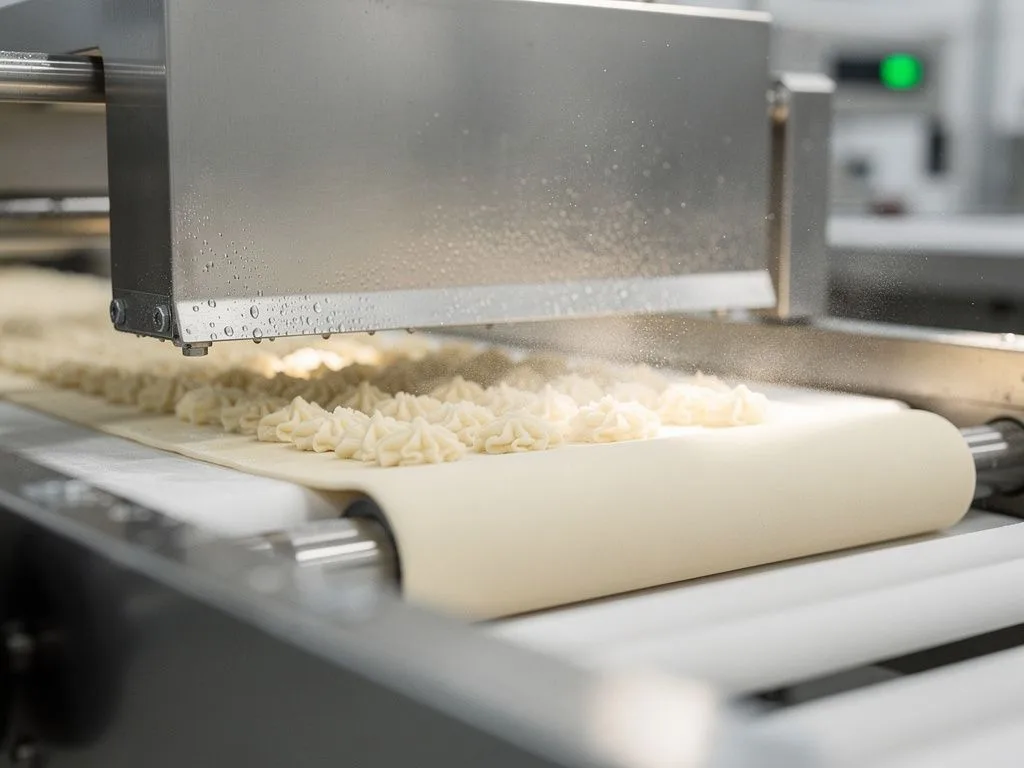
Filling-to-wrapper ratio and mold changeover are the two most critical factors before sharing a dumpling machine across products
The filling-to-wrapper ratio of a dumpling machine is determined by three variables: the mold opening, dough sheet thickness, and filling volume. Adjusting any one of these requires replacing the corresponding forming module. The same machine can produce potstickers and wontons through mold changeover, but the filling-to-wrapper ratio, dough formula, and filling parameters must be recalibrated for each product, with trial runs confirming actual gram weight and sealing quality. When evaluating a shared machine, buyers should first clarify the filling-to-wrapper ratio range of their product line, then request the corresponding molds and trial run conditions from the equipment supplier.
How is the filling-to-wrapper ratio of a dumpling machine determined?
The filling-to-wrapper ratio of a dumpling machine is not set by a single dial but is jointly determined by three variables: the mold opening size, dough sheet thickness, and filling volume. The mold opening determines the diameter of the dough disc and the shape of the crimped edge; the thickness determines the wrapper weight; and the filling volume determines the filling weight. When the proportion of these three changes, the filling-to-wrapper ratio changes accordingly. In practice, if a buyer wants the ratio to fall within a specific range, they must first provide the target gram weight, dough thickness, and filling moisture content, so the equipment supplier can recommend the corresponding mold specifications and filling parameters. To produce thin-skinned, heavily filled potstickers and thick-skinned, lightly filled traditional dumplings on the same machine, the forming module usually needs to be replaced rather than just adjusting a dial. Buyers should list the filling-to-wrapper ratio as a mandatory question during the inquiry stage and request actual gram weight data from trial run samples as the acceptance basis.
When changing molds, which components must be replaced together?
Mold changeover is not just about replacing the forming module; it requires synchronously replacing the dough sheeting rollers, forming wheels, filling screw, or metering pump according to the product specifications. The gap between the sheeting rollers determines dough thickness. If the new product's thickness requirement differs from the original setting beyond a certain range, fine adjustment alone cannot maintain uniform thickness. The groove shape of the forming wheel determines the number of crimps and the appearance. The double crimp of dumplings and the long strip seal of potstickers are different groove designs and cannot be shared. The filling screw or metering pump affects filling density and per-piece gram weight. High-moisture meat fillings and low-moisture vegetable fillings require different filling structures. When evaluating a shared machine, buyers should request a complete mold list and corresponding product specification table from the supplier, confirm the interchangeability and inventory status of each component, and avoid downtime due to missing parts during changeover.
When switching from dumplings to wontons, which parts of the machine need recalibration?
When switching from dumplings to wontons, the machine needs recalibration of dough sheet thickness, filling volume, forming wheel speed, and sealing pressure. Wonton wrappers are thinner and smaller, so the gap between the sheeting rollers must be reduced, and the gluten strength and moisture content in the dough formula must be adjusted accordingly, otherwise the wrapper may crack during forming. Since the per-piece gram weight of wontons is smaller than that of dumplings, the filling screw speed or metering pump stroke must be reset, with actual gram weight from trial run samples as the acceptance standard. The forming wheel speed affects crimp quality. Wonton forming is usually faster than dumplings; if the speed is not adjusted synchronously, uneven tension may occur at the seal. Sealing pressure is adjusted based on dough thickness and moisture content. Too much pressure will break the wonton wrapper, while too little will result in a weak seal. Buyers should require the supplier to provide the trial run procedure and parameter table after mold changeover and confirm the training hours for on-site operators.
When the skin-to-filling ratio changes, does the filling formula need to be adjusted?
When the skin-to-filling ratio changes, the filling formula usually needs to be adjusted accordingly; otherwise, both forming quality and taste will be affected. When switching from a thick skin with less filling to a thin skin with more filling, the adhesiveness and moisture content of the filling must be increased; otherwise, the filling may scatter or release moisture during the filling and sealing process. The fat-to-lean ratio in meat fillings, the degree of dehydration in vegetable fillings, and the resting time after seasoning all affect filling stability. If a buyer plans to produce multiple skin-to-filling ratios on the same line, they should first establish a comparison table of filling formulas and skin-to-filling ratios, and then have the equipment supplier plan the filling-end specifications accordingly. In practice, filling temperature is also a key variable. Chilled meat filling and room-temperature meat filling have different flow properties, so the filling parameters need to be adjusted accordingly. During the trial run stage, buyers should prepare the actual filling to be used in production rather than testing with substitutes, in order to obtain parameters close to mass production.
When sharing a machine, how should the time cost of mold change during downtime be estimated?
When sharing a machine, the time cost of mold change during downtime includes five stages: disassembly, cleaning, installation, calibration, and trial run. Disassembly and installation time vary depending on the mold structure and operator proficiency. Forming modules with simple structures can be completed in a short time, while filling ends with complex structures require longer. Cleaning time cannot be omitted; residual dough and filling will affect the hygiene and forming quality of the next product. Especially when switching from meat filling to vegetable filling, the risk of cross-contamination must be considered. Calibration and trial runs should use actual gram weight and sealing appearance as acceptance criteria. Buyers should require the equipment supplier to provide standard operating procedures and estimated time for a single mold change. In practice, if orders involve frequent line changes among multiple products, total mold change time may take up considerable capacity. Buyers should include this cost when evaluating the number of machines.
What information should buyers prepare when inquiring about skin-to-filling ratio and molds with equipment suppliers?
When inquiring about skin-to-filling ratio and molds with equipment suppliers, buyers should prepare a list of target products, the single-piece gram weight of each product, the skin-to-filling ratio range, dough thickness, and filling characteristics. The target product list should specify items such as dumplings, potstickers, wontons, and their size specifications. The single-piece gram weight should distinguish between skin weight and filling weight, not just total weight. The skin-to-filling ratio range should be based on actual market demand; for example, thin-skin potstickers with more filling and traditional thick-skin dumplings with less filling fall into different ranges. Dough thickness affects the specifications of the sheeting rollers, while filling characteristics include moisture content, viscosity, and particle size, all of which determine the choice of the filling end. If buyers can provide actual flour and filling samples used in production, the equipment supplier can arrange trial runs and report actual forming results, which is closer to mass production conditions than communicating only with specification sheets.
Six key points buyers must ask when evaluating skin-to-filling ratio and molds
Mold opening and dough diameter correspondence table
Confirm that the equipment supplier can provide the mold opening size and the formed dough diameter for different products, as the basis for skin-to-filling ratio calculation.
Adjustable range of sheeting rollers
Understand the adjustable range of the sheeting roller gap to determine whether it covers the dough thickness requirements of the target products, avoiding exceeding machine limits.
Filling end specifications and applicable fillings
Confirm the moisture content and particle size of fillings that the screw or metering pump can handle, to avoid unstable filling during actual production.
Forming wheel interchangeability and inventory
Ask whether forming wheels for different products can share the same base, as well as spare parts inventory and lead times, to avoid downtime due to missing parts during mold changes.
Single mold change time and trial run process
Require the equipment supplier to provide standard mold change procedures and estimated time, as a basis for evaluating downtime costs and order scheduling.
Trial sample gram weight and sealing acceptance criteria
Confirm the acceptable gram weight range and sealing appearance standards for trial samples, to avoid discovering specification mismatches only after mass production.
Dough-to-Filling Ratio and Mold Specifications Are Ultimately Confirmed by Trial Samples
All discussions regarding the dough-to-filling ratio and mold specifications must ultimately be validated based on the actual weight and sealing appearance of trial samples. The figures on the specification sheet are theoretical values; actual forming results are affected by flour gluten strength, filling moisture content, room temperature, and operating techniques. If buyers sign contracts based solely on the specification sheet, discrepancies are likely to arise during mass production. During the trial run, use the actual production ingredients, and have the buyer's personnel operate the machine on-site, while the equipment supplier adjusts parameters based on the on-site results. Trial samples must be measured for individual dough weight, filling weight, total weight, and sealing pull strength, and these data should be included in the acceptance documentation. At the contract stage, buyers should agree on trial conditions, sample quantities, and re-inspection procedures to ensure a clear basis for the final step before mass production.
Need to Plan Dough-to-Filling Ratios and Mold Configurations Based on Your Product Line?
Please provide your target product list and dough-to-filling ratio requirements, and we will confirm the corresponding mold combinations and mold change procedures based on the actual specifications.