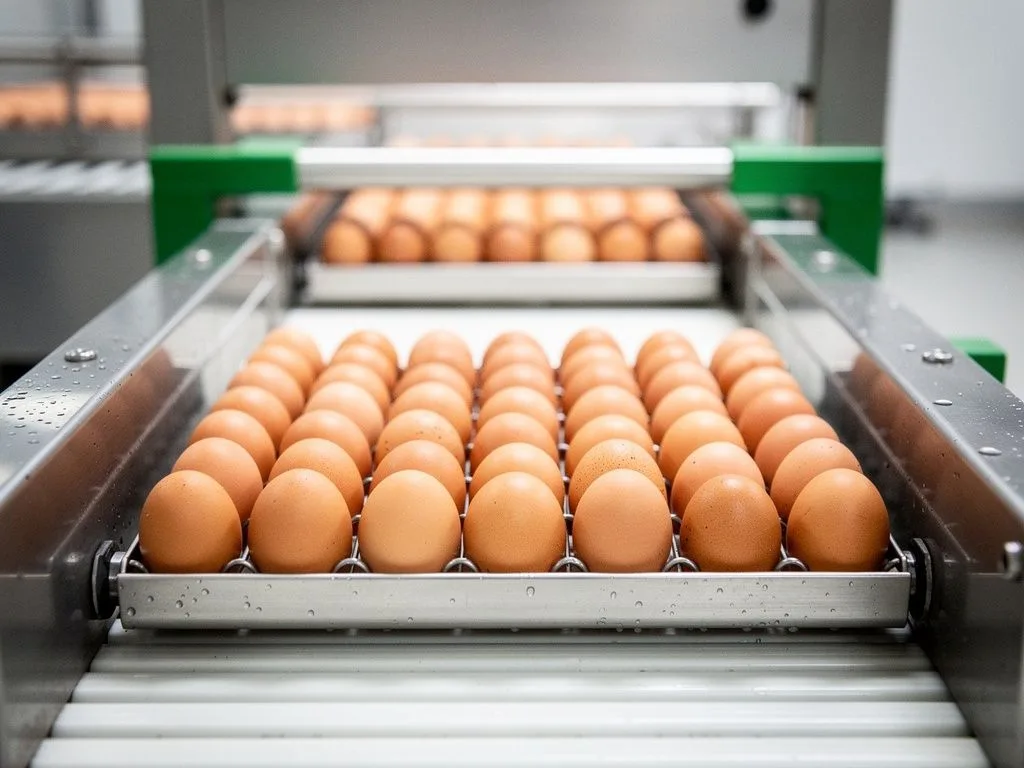
How the Egg Breakage Rate Affects Overall Line Efficiency
The egg breakage rate is the most commonly underestimated cost variable in an egg processing line: every additional broken egg means one less portion filled, one empty slot in the egg-steaming mold, and one more unit of waste at the downstream stage. When comparing egg liquid mixing, metering, and filling systems with continuous egg-steaming and forming lines, buyers should treat the breakage rate as a required field in the RFQ and ask suppliers to explain, section by section, the protective designs for washing, conveying, breaking, filling, and steaming—rather than looking only at the rated capacity of individual machines. The difference in overall line efficiency is often hidden in these few percentage points.
Why Does the Breakage Rate Directly Eat into Filling Section Yield?
The yield of the egg liquid filling section is calculated using the number of intact eggshells that can be filled as the denominator. Once breakage occurs, the denominator shrinks and the line must slow down to compensate. When reviewing filling machine specifications, buyers should ask three questions: the tolerance range of the suction nozzle for eggshell deformation, the design for separating eggshells from egg liquid after breaking, and the feedback compensation mechanism for filling volume. Without these three layers of protection, every one-percentage-point increase in the breakage rate reduces the effective output of the filling section proportionally, and the downstream continuous egg-steaming and forming line will also stop due to material shortage. For liquid egg processors, the breakage rate is not just a quality control figure—it is the invisible ceiling on line utilization. In practice, common breakage scenarios in the filling section include: uneven eggshell thickness causing misalignment of the suction nozzle, mixed batch egg weight specifications causing metering errors, and eggshell fragments falling into the egg liquid conveying pipeline after breaking. All three scenarios force the filling section to slow down or stop for cleaning, which in turn affects the feeding rhythm of the egg-steaming and forming line. When preparing an RFQ, buyers should include these three scenarios as test conditions and require suppliers to demonstrate the corresponding protective actions during the trial stage, rather than discovering the yield loss only after mass production.
What Chain Reactions Does Egg Breakage Cause on a Continuous Egg-Steaming and Forming Line?
Continuous egg-steaming and forming lines are highly sensitive to egg liquid quality. If eggshell fragments or liquid from broken eggs are mixed in, the steaming stage can produce air holes, collapse, and discolored patches, creating a high risk of whole-batch rejection. Buyers should ask suppliers to explain: the filtration and debris removal design between filling and mold entry, the temperature uniformity of the mold slots, and the automatic rejection logic for abnormal egg liquid. In practice, more than 70% of yield fluctuations on egg-steaming lines can be traced back to the handling of broken eggs in the upstream filling section. Therefore, when evaluating a complete line, filling and steaming must not be assessed separately; the unit of evaluation should be the breakage protection chain from eggshell to finished product. For buyers processing boiled eggs, hot spring eggs, and steamed egg products, the appearance of the finished product is the basis for pricing in the end market. Once air holes or patches appear, the entire batch can only be downgraded or scrapped, which also affects delivery schedules and customer trust. During the negotiation stage, buyers should write the minimum yield for steamed egg products into the contract and require suppliers to provide a yield distribution chart from continuous trial runs, rather than a single aggregate figure.
How Do the Washing and Conveying Sections Determine the Baseline Breakage Rate for the Entire Line?
The washing and conveying sections are the starting point of the breakage rate. Water temperature differences, brush pressure, and the impact points on eggshells along the conveyor all determine whether the downstream sections can maintain yield. When reviewing a complete plant planning proposal, buyers should ask suppliers to specify: the control range of washing water temperature, brush material and rotation speed, the turning radius and buffer design of the conveying section, and the position of automatic optical inspection for eggshell cracks. These parameters directly affect the baseline breakage rate before eggs enter the filling machine. If the baseline is too high, no matter how good the downstream filling and steaming designs are, they cannot compensate. This section is especially critical for high-temperature, high-humidity production lines in Southeast Asian markets such as Thailand. Buyers can further ask suppliers to explain: the allowable range between washing water temperature and ambient temperature, whether the brush material complies with food contact regulations, the effect of conveyor belt material on the friction coefficient of eggshells, and the false detection rate of optical inspection and the logic for diverting rejected eggshells. These details determine whether the baseline breakage rate of the entire line can be kept within an acceptable range, and they are also the prerequisite for stable operation of the subsequent filling and steaming sections.
Which fields in the RFQ should buyers use to specify the egg breakage rate?
The RFQ should break the egg breakage rate into three fields: the maximum breakage rate before the filling machine, the maximum breakage rate in the filling section, and the maximum defect rate of the finished steamed egg products. Together, these three figures represent the true line yield. Buyers should also require suppliers to provide the test conditions for sample trials, including the eggshell thickness range, egg weight specification, test batch size, and ambient temperature and humidity, and specify who will execute the test method. Without these conditions, the breakage rate figure is just marketing talk and cannot serve as an acceptance basis. For turnkey plant projects, the breakage rate should be written into the contract acceptance clauses, not just listed in the quotation notes. When preparing the RFQ, buyers can also request suppliers to provide: the control curves for egg washing water temperature and brushing pressure, the false rejection rate of the optical inspection on the conveyor section, the deformation tolerance test report for the filling nozzles, and the measured temperature uniformity distribution of the steamed egg mold cavities. Only when these attachments are listed alongside the three breakage rate fields can subsequent acceptance be based on objective evidence, avoiding specification distortion after price negotiation.
When a filling machine and an egg processing line share the same plant, do the breakage rates affect each other?
Yes. If a filling machine (such as a tabletop electric dumpling machine or a high-speed wonton filling machine) operates in the same plant and shares the same workflow as the egg line, the vibration and washing water from the filling machine can introduce additional moisture and micro-vibration into the egg washing and filling sections, indirectly increasing the egg breakage rate. When planning the plant layout, buyers should require the supplier to isolate the egg washing and filling areas from the filling machine operation area in terms of humidity and vibration, and to indicate the diversion design for shared drainage and cleaning workflows. The value of whole-plant planning and turnkey projects lies in eliminating these cross-product-line interference factors in advance, rather than remedying them afterward. In practice, common interference scenarios in a shared plant include: splash water from cleaning the filling machine entering the egg washing area, micro-vibration from the high-speed operation of the filling machine being transmitted through the floor to the filling machine base, and backpressure in shared drainage lines during peak cleaning times. All three scenarios can push the baseline breakage rate, which was originally designed to be within tolerance, higher. Before price negotiation, buyers should require the supplier to provide corresponding isolation and diversion design drawings.
How can sample testing verify a supplier's claimed egg breakage rate?
To verify the breakage rate, buyers should not rely solely on catalog figures. During sample testing, buyers should require the supplier to record three sets of data simultaneously: the number of cracked eggs after the washing and conveying section, the number of cracked eggs in the filling section, and the number of eggshell fragments detected in the finished steamed egg products. The test batch size should be based on the actual production batch, the ambient temperature and humidity should be noted, and the test video and original records should be kept as acceptance attachments. If the supplier only provides a single aggregate figure without segment-by-segment disclosure, buyers should treat it as an incomplete specification and place the supplier on a shortlist but not proceed with price negotiation. Segmented data is the only basis for judging whether the whole line's egg breakage protection is effective. Buyers can further require the supplier to provide during the sample stage: the thickness and weight distribution of the test eggshells, temperature and humidity records of the test environment, the marked locations of each breakage occurrence, and the trigger conditions for automatic removal of abnormal egg liquid. Only when these attachments are listed alongside the three sets of data can it be determined during the acceptance stage whether the whole line's egg breakage protection meets the RFQ specification, avoiding a single aggregate figure masking segment weaknesses.
How should the trade-offs among egg breakage rate, whole-line energy consumption, and cleaning time be evaluated?
The egg breakage rate is not an isolated indicator; it is interconnected with whole-line energy consumption, cleaning time, and downtime frequency. When evaluating the overall line efficiency, buyers should require the supplier to provide the interrelationships among these three factors: the energy consumption changes caused by speed reduction in the filling section when the breakage rate rises, the extension of cleaning cycles after abnormal egg liquid removal, and the production capacity loss of the steaming line due to downtime for replenishment. In practice, a common blind spot for buyers is focusing only on single-machine capacity and breakage rate while ignoring the total cost after considering the interconnections among these three factors. The true indicator of whole-line efficiency is the production cost per unit of qualified finished product over time, not the labeled capacity of a single machine. When preparing the RFQ, buyers can require the supplier to provide: a comparison table of energy consumption and breakage rate, records of cleaning cycles and abnormal removal counts, and an estimate of the steaming line capacity loss due to downtime for replenishment. Only when these three attachments are listed alongside the breakage rate fields can the true return on investment of the whole line be judged during the price negotiation stage.
Six design points buyers must review when evaluating whole-line egg breakage protection
Washing water temperature and brush pressure control
Excessive temperature differences can cause thermal stress cracks in eggshells. Brush pressure should be adjustable based on shell thickness ranges, with control limits clearly indicated.
Conveyor buffering and optical inspection
The turning radius, buffer pad material, and the position of automatic crack rejection determine the baseline breakage rate before eggs enter the filling machine.
Filling nozzle deformation tolerance design
The nozzle's tolerance for shell deformation and the logic for diverting cracked shells directly affect yield in the filling section.
Post-filling debris removal and abnormal rejection
The filtration design after filling and before molding, along with automatic rejection of abnormal egg liquid, serves as the final safeguard for steamed egg line yield.
Temperature uniformity in steamed egg mold cavities
Temperature uniformity in the mold cavities affects porosity and collapse rates in the finished product, and should be evaluated together with the upstream egg breakage protection chain.
Humidity and vibration isolation in overall plant layout
When the egg line shares the plant with a filling machine, the layout separation and vibration isolation design will in turn affect the baseline breakage rate.
Make breakage rate a primary specification in your whole-line RFQ, not a footnote
Most buyers only ask about single-machine capacity when issuing an RFQ, while relegating breakage rate to the remarks column. This leads suppliers to prioritize capacity in their responses, pushing breakage protection design off the agenda. The correct approach is to elevate breakage rate to a primary specification field, listed alongside capacity, energy consumption, and cleaning time, and require suppliers to clearly indicate protection designs and trial testing conditions by section in their proposals. For buyers of liquid egg processing and steamed egg products, every one percentage point reduction in breakage rate equates to a one percentage point increase in annual line capacity—an investment direction with greater leverage than upgrading individual machines. Before issuing an RFQ, buyers should first take stock of their own line's eggshell specifications, batch sizes, plant temperature and humidity, and whether the line shares traffic flow with a filling machine. Sending these conditions together with a three-section breakage rate field allows suppliers to align specifications in the first round of proposals, avoiding specification distortion or change orders during later price negotiations.
Send us your egg line conditions and we will assess breakage protection section by section
Please provide eggshell specifications, estimated batch size, plant temperature and humidity, and whether the line shares traffic flow with a filling machine. We will confirm the whole-line breakage protection design and trial testing conditions based on your actual specifications.